
About Me

Hey! My name's Ujjwala Singh and I'm a 19 year old Law student at Kings College London! This page is where I pen down my thoughts & feelings about art, architecture and literature in articles, alongside some of my poetry! I also upload Notion templates, Wallpapers & other organizational goodies:) I hope you love it!
Salvador's Suit

Find out about Salvadore Dali and his Diving Suit escapade!

Articles

The Great Wave off Kanagawa

One of the most recognizable art pieces in the world - but what's the story behind it?

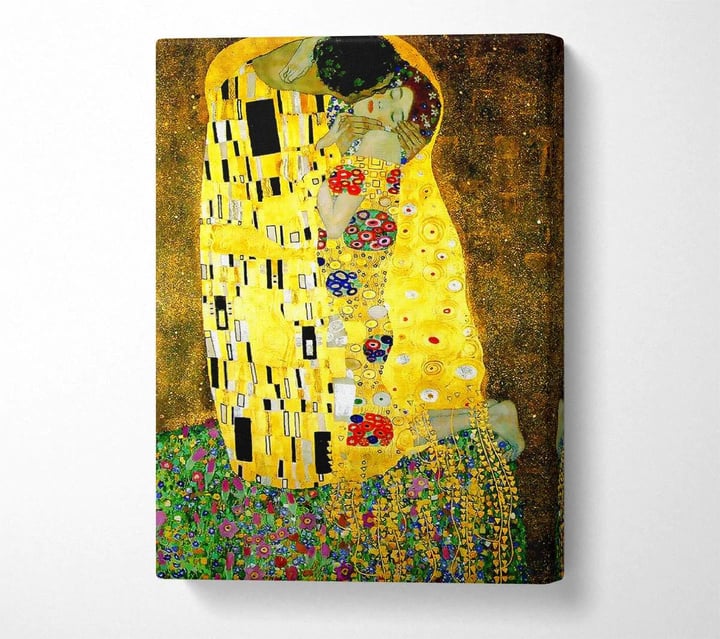
Klimt's Kiss

Find out more about Gustav Klimt & his controversial piece - The Kiss!

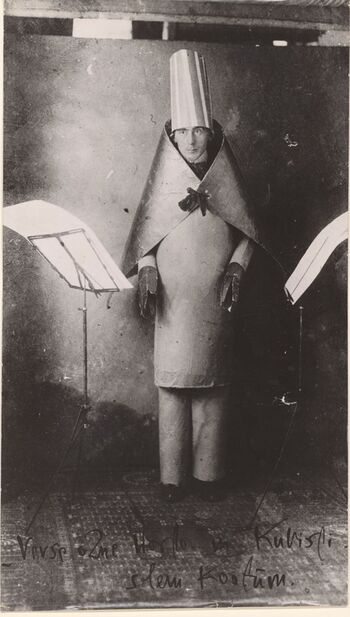
Dada Movement

This article delves into the First World War's effect on creative expression & art
Overton window

This article discusses how Joseph P. Overton coined one of the most used terms in political & public discourse today.

Others

Add Button Icon

Instagram:

Ujjwala Writes

Writing Account

My Pinterest

Add Button Icon
pinterest
Add Button Icon
Song Interface

My

Spotify

Notion Templates

Button Flat Illustration

Daily Workspace

Button Flat Illustration

To Be Read

Button Flat Illustration

Project 50

Wallpaper

DESKTOP

Wallpaper

PHONE

Salvador's

Suit

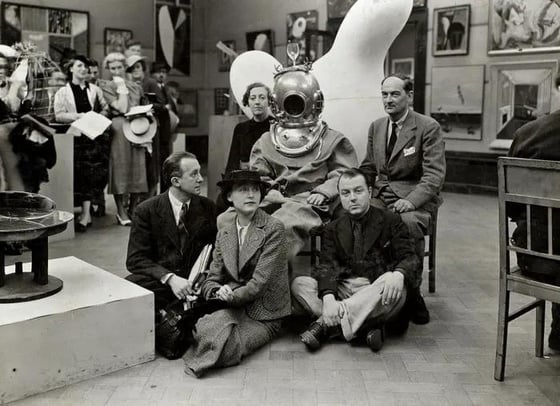
In a symbolic attempt to ‘dive into the human subconscious’, one of the most profound names in the Surrealist art movement – Salvador Dali – arrived at the 1936 International Surrealist Convention dressed in a scuba suit.

What began as a simple exhibition that was meant to showcase surrealism to the British public, soon turned into an event that would be remembered by everyone for years to come. Surrealism, an art movement that began in 1924, had spread rapidly through various geographies and entertained the most unique artistic minds the world has witnessed.

The motive of all revolutions is to bring about change and push society’s boundaries, and the surrealist movement was no different in this sense. Its founder, Andre Breton, wished to liberate the masses from oppressive rational thought, and hoped to release their intellectual capacities. The age of enlightenment that had preceded the surrealist movement was thought by many creatives to have repressed the irrational flow of the unconscious human mind. The responsibility of its’ liberation was therefore taken on by the likes of Marcel Duchamp, Salvador Dali and Picasso among many others that followed in Bretons’ footsteps.

Although the surrealist movement encompassed various forms of individual expression, Salvador Dali’s art mainly focused on hyper-realistic almost dream like visions. The International Surrealist Convention at which Dali spoke changed the course of British art, and was in fact designed to show the British people what Surrealist art was truly about. In order to make a true impact, Dali therefore arrived at the exhibition dressed up in a complete scuba diving suit. During the lecture, he almost suffocated to death because of his eccentric get up, and when he moved his arms in order to call for help, the audience, assumed that it was a part of his usual antics. He continued his lecture after he was saved from his near-death experience, and the rest of his slides were presented upside down which, after the scuba suit incident, didn’t startle many. In this way, Salvador Dali singlehandedly orchestrated one of the most interesting moments in the history of art, and like his peers, impacted the movement heavily.

Ujjwala Singh

The Great Wave off Kanagawa

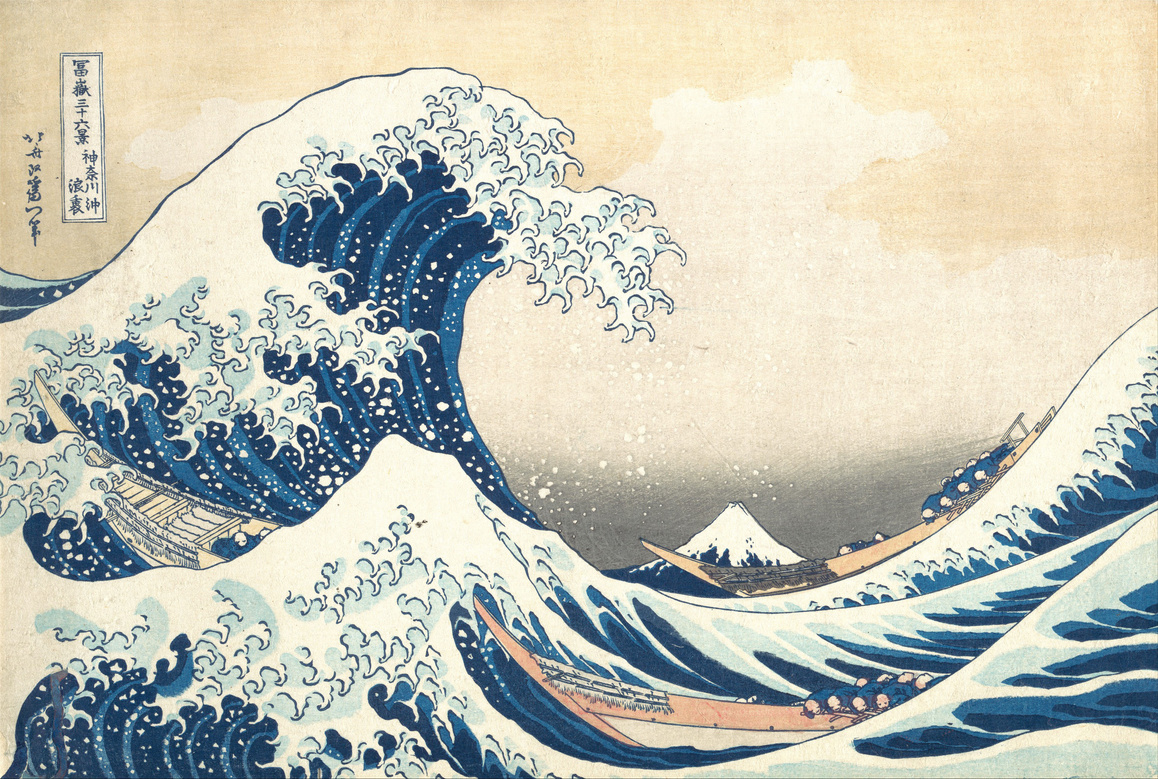
The Great Wave Off Kanagawa. The piece is understood to be the most renowned piece of Japanese art in the world, but what do we know about the art form behind it? Published roughly between 1829 and 1833, the piece was created by Hokusai as a part of his series – Thirty-six views of Mount Fuji. The piece was retained in Japan until1859 and wasn’t even recognized as true art until it found a global audience. It was through a huge flow of Japanese prints into Europe that The Great Wave found validation and appreciation from artists such as Monet and Van Gogh.

Although the piece is widely misinterpreted as a painting, it is actually a print. Woodblock Printing was first used in the 8th century in order to reproduce texts such as Buddhist scriptures. The usage of the printing form for illustrations only begun in the early 1500s, which paved the way for the now prevalent art form to come into existence.

In the beginning of its journey, ukiyo-e (woodblock prints) was used to mass produce pictures of kabuki actors and courtesans. Since the prints were produced in large numbers, their prices were about as much as a bowl of noodles at the time. It was only in the 19 th century that ukiyo-e artists began to focus on landscapes after the construction 5 major highways which connected Edo (modern day Tokyo) with the rest of the country. Travel was at an all time high, and Hokusai was one of the 2 greatest landscape artists of the time. Whilst his counterpart, Hiroshige, focused on his series – Fifty-three stations of the Tokaido – Hokusai directed his attention to the sacred Mount Fuji and its appearance during different seasons.

Although the piece is not purely Japanese (in style), since it takes inspiration from linear perspectives found in Dutch art, it does serve to be the face of the Japanese art world and continues to be showcased in museums across the world.


Ujjwala Singh

The Kiss

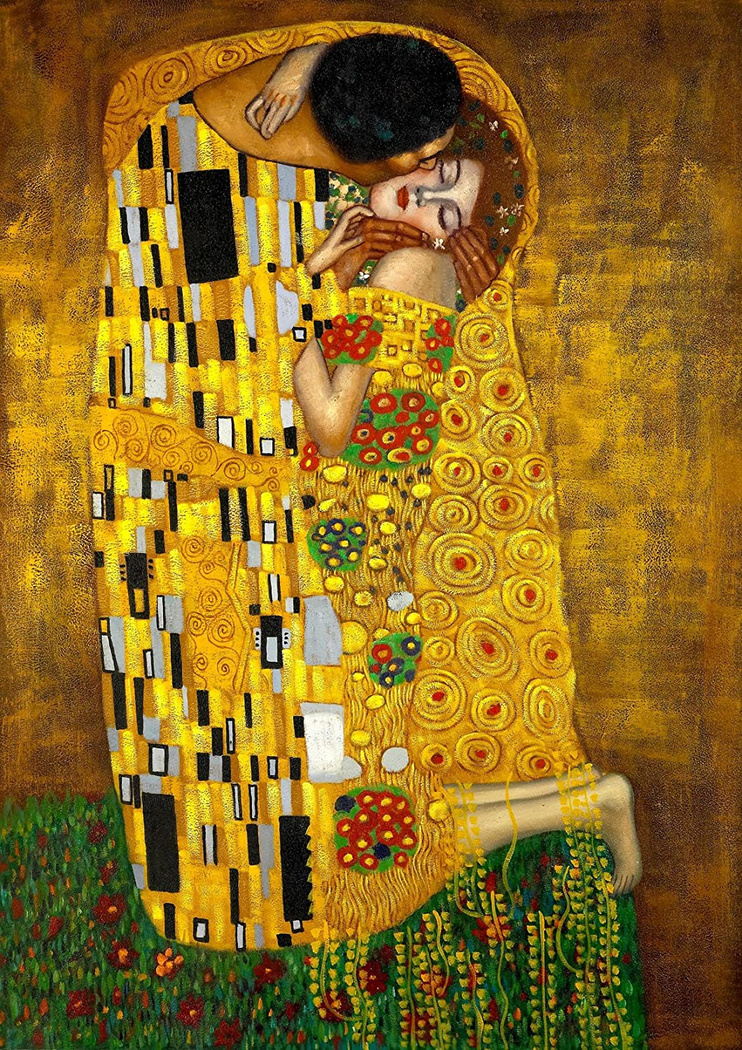
Painted during his Golden Period, Gustav Klimt’s ‘The Kiss’ still stands as one of the most ethereal paintings witnessed by the realm of art over the years. Through the gold leaf detailing noticed in

many of Klimt’s paintings during this time, including Judith and the Head of Holofernes (1901), and Water Serpents I (1904), Klimt manages to intensify the elegance he wishes to portray through these works.


The ambiguity and mystery of love was explored heavily in the Golden Epoch phase, wherein several ornamental pieces of art were made in order to understand the depths of human emotions. The theme of love and intimacy is explored by Klimt in many of his works, however The Kiss is one of his most recognized pieces, and also the last in which he used gold embellishments.


As a founder and the first president of the Vienna Secession movement, Klimt had faced a lot of criticism by the more conservative elements of society, with individuals going to the extent of calling his works pornographic. This particular piece depicts a couple upon a patch of wildflowers with the man leaning in to kiss his lover. A sense of peace and tranquillity is felt through the gentle way in which the woman’s eyes are closed while she embraces her partner, and the piece in itself offers the viewer a sense of tenderness and warmth to its viewers.

The identity of Klimt’s muse in this composition is argued over, but many believe that Emilie Floge – an Austrian fashion designer and businesswoman - was the inspiration behind the art. As for the inspiration behind the style of the piece, most opine that Klimt was stimulated by his trip to Ravenna where he was introduced to Byzantine mosaics. The bold deterrence from socially acceptable artwork defined Klimt’s pieces, and the controversial piece went on to become on of the most acclaimed works of art. With various intricacies, the piece continues to fascinate everyone that chances upon it and remains one of the first to open society’s mind to more explicit art.


Ujjwala Singh

Anti Art


Hugo Ball & The Dada Movement

The tragedies of World War I were numerous, and it’s aftermath was felt not only in every day life, but in every sphere of the human existence. As a reaction to the horrors and insanity of World War I, many artistic and creative persona’s decided to break all the rules that regulated their respective fields. The result? A movement that would change the future of expression forever

The start of the Dada Movement was found in the likes of Hugo Ball, most known as the owner of the Cabaret Voltaire. Ball relished the performing arts and was a producer before The Great War broke out. However, this had no bearing on his readiness to fight alongside his fellow men for his country. As soon as the news of the war broke, Ball, like many others, attempted to enroll in the military. However, after being denied this opportunity due to medical conditions, Ball found himself in state of deep despair. His helplessness made it difficult for him to deal with the atrocities the war brought, and this difficulty all too soon became an encumbrance that Ball could not handle.


In response to the alienation from normal life, Ball decided to open the Cabaret Voltaire. It was here that the beginnings of the Dada Movement were formed. Ball used the medium of Sound Poetry, which uses phonetic sounds rather than actual words, to express his feelings about the war. The combination of unreal and nonsensical sounds that Ball exuded were meant to represent the incoherence of the war. It made no sense, not only to Ball but to thousands of people during the war, how living people could be used by those in power as if they were machines; As if the horrors of death and murder would have no implication on their well-being and health. He boldly stated, “The war is founded on a glaring mistake - men have been confused with machines.” , after which he was forced to flee from his country.


Through this new found language, Ball wished to "return to the innermost alchemy of the word". He felt as though regular language, which was controlled and regulated by thousands of rules, was the reason (or at least a cause) for the war. His blatant disregard for rules served to allow artists in other fields such as literature and art to follow suit.


Revered artists such as Marcel Duchamp, Salvador Dali and Francis Picabia, to name a few, picked up on the message behind the Dada Movement and contributed to it in ways no one thought were possible. The aim of the movement was simple: To destroy the traditional and replace it with the new. Boundaries were broken and longstanding conventions were met with total disregard, all of which culminated in the complete removal of boundaries from creativity & expression. In addition to changing the narrative within creative realms, the movement inspired the birth of other forms of expression, such as Surrealism, Pop art, Fluxus, etc.


All in all, the Dada movement stood to represent post-war disillusionment in a way that no other movement had come close to doing. By going against the grain and amplifying the disgust many around the world felt about the war, the Dada Movement housed artists that are now looked at with unparalleled respect, and allowed creatives to truly reveal their most intimate emotions at a time when such an outlet was paramount.


Ujjwala Singh

the

Overton

Window

The range of policies deemed acceptable by society in public discourse is forever shifting. When making this decision, it is often taken into consideration whether the


policies at hand have a quality of propriety. Policies that could have hitherto been seen by society as ridiculous, bizarre or farcical can, over time, morph to be seen as commonplace, rational and acceptable. To explain this range of ‘acceptable’ policies, Joseph P. Overton introduced the concept of the Overton Window in the mid-1990s.

What began as a simple term to explain (to his potential donors) the purpose of a think tank, turned into a concept that would be used in political discourse for decades to come. Overton, with the help of a brochure and a cardboard slider, presented all the possible policies that could surround a particular issue (in this case education) from least to most government intervention. On one end was the policy of zero public investment in education, i.e., investment from the State. On the other end was the policy of compulsory indoctrination in government schools, i.e. The pupils that attended government schools had no choice in the ideas, morals, beliefs, etc. that they would subscribe to.


On these extremes were policies that Overton stated wouldn’t be viable in any scenario. However, in between these extremes was a range of policies that had considerable viability and could be termed acceptable. This range of policies is what we now know as the Overton Window. In other words, the Overton Window represents political possibility. Not everyone agrees on the ideas inside this window, but it is okay to infer that the ideas that lie within it relate to some level of normalcy.


As all fluctuant concepts, the Overton Windows’ shift depends upon the progression of ideas as time barrels forwards. When politicians deliberate on policy formulation, they understand that those policies can’t be created on the basis of personal whims and fancies, no matter how strong their personal beliefs are. They must hold some form of acceptance by the society at large. The factors that shift the Overton Window include cultural change, political action, moral standings, advocacy, etc. Of course, all of these factors take time to become impactful enough to change the mindsets of the general public. There can therefore be a lag between the time a particular change occurs in society and when policy or legislation reflects this change.


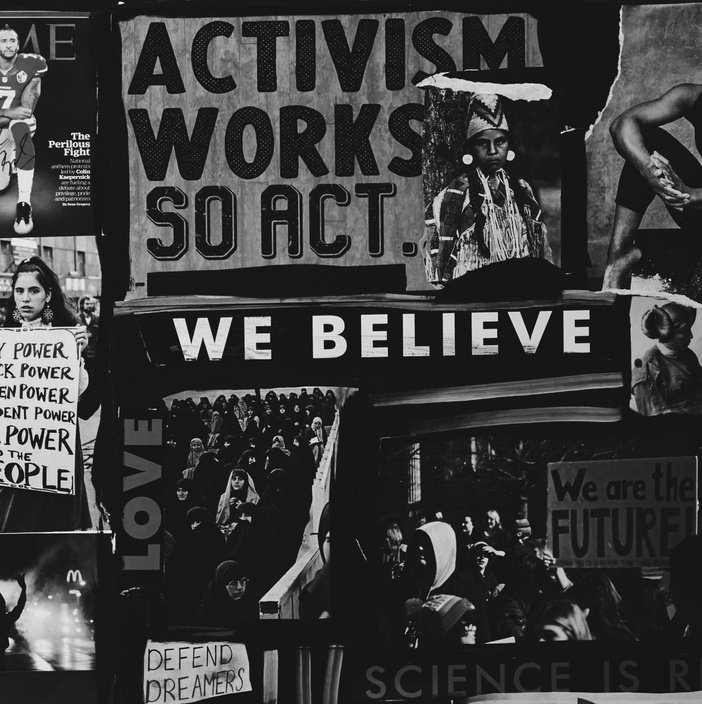
One example of how these shifts work can be found in the women’s vote. After various protests and measures, it became more acceptable to give women the right to vote. The Overton Window’s range changed parallel to this progression. Other examples of changes that shifted the Overton window are the abolition of slavery, expansion of moral circles in relation to animal welfare, advocacy for gay marriage, etc. Proof that the Overton windows’ shift has a direct impact on how society functions and the policies that run it can be seen in the growing support for same sex marriage in the US. A concept that once wasn’t near even the extremities of the Overton window, now dwells within its safe spaces and has also obtained legal backing.

The changes in the range of socially acceptable ideas show that the Overton window was an important concept long before it was termed, and continues to show us how our ideals, values, decisions and mindsets develop and advance over time. In conclusion, the Overton window does not dictate what is good or bad, or even give us the slightest idea of what should or should not constitute acceptable policies. Instead, it only serves to make the mindsets of the general public more transparent and dictate the types of policies that can be put out into the hands of the public while having some magnitude of viability. It shows the policies that the public are currently willing to accept/consider, and helps politicians with policy formulation.


Ujjwala Singh

Gmail

personal

ujjwalaxsingh@gmail.com

Gmail

business

ujjwalasinghbusiness@gmail.com